Welcome to DU!
The truly grassroots left-of-center political community where regular people, not algorithms, drive the discussions and set the standards.
Join the community:
Create a free account
Support DU (and get rid of ads!):
Become a Star Member
Latest Breaking News
Editorials & Other Articles
General Discussion
The DU Lounge
All Forums
Issue Forums
Culture Forums
Alliance Forums
Region Forums
Support Forums
Help & Search
Environment & Energy
Related: About this forumScientists stunned: Volcano cleans up after itself by removing methane from the air
https://news.ku.dk/all_news/2026/05/scientists-stunned-volcano-cleans-up-after-itself-by-removing-methane-from-the-air/7 May 2026
climate A violent volcanic eruption in the South Pacific has revealed a surprising natural mechanism that could potentially help slow global warming. The finding provides entirely new insights into atmospheric chemistry and may inspire new methods to remove methane emissions from the air.
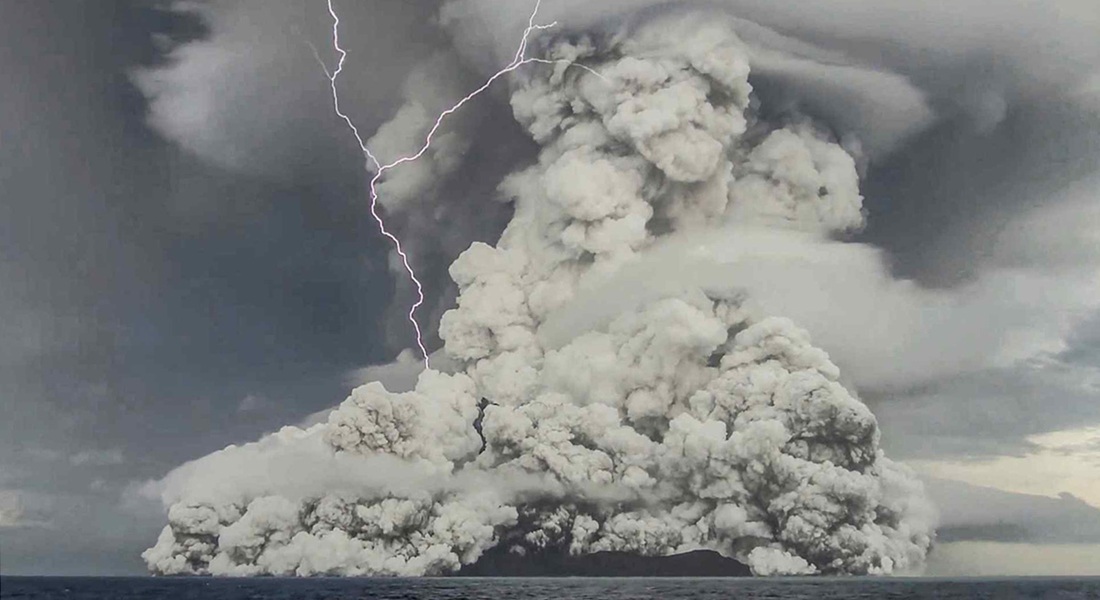
The Hunga Tonga–Hunga Ha'apai-volcanic eruption on 15 january 2022. Image taken from a video of the eruption. Source: Tonga Geological Services
When the submarine volcano Hunga Tonga–Hunga Ha’apai in the South Pacific erupted in January 2022, it was not only one of the most violent volcanic eruptions in modern times. The volcano also did something completely unexpected: it helped clean up some of the methane pollution it released. This phenomenon could potentially be key to how humans can slow global warming.
Using advanced satellite measurements, researchers observed unusually high concentrations of formaldehyde in the massive volcanic plume following the eruption. This was crucial evidence: when methane is destroyed in the atmosphere, formaldehyde forms as a short-lived intermediate.
“When we analysed the satellite images, we were surprised to see a cloud with a record-high concentration of formaldehyde. We were able to track the cloud for 10 days, all the way to South America. Because formaldehyde only exists for a few hours, this showed that the cloud must have been destroying methane continuously for more than a week,” explains Dr. Maarten van Herpen from Acacia Impact Innovation BV, first author of the study, which has just been published in Nature Communications.
“It is known that volcanoes emit methane during eruptions, but until now it was not known that volcanic ash is also capable of partially cleaning up this pollution,” he adds.
…
van Herpen, M.M., De Smedt, I., Meidan, D. et al. Satellite quantification of enhanced methane oxidation applied to the stratospheric plume following Hunga Tonga-Hunga Ha’apai eruption. Nat Commun 17, 3746 (2026). https://doi.org/10.1038/s41467-026-72191-4climate A violent volcanic eruption in the South Pacific has revealed a surprising natural mechanism that could potentially help slow global warming. The finding provides entirely new insights into atmospheric chemistry and may inspire new methods to remove methane emissions from the air.
The Hunga Tonga–Hunga Ha'apai-volcanic eruption on 15 january 2022. Image taken from a video of the eruption. Source: Tonga Geological Services
When the submarine volcano Hunga Tonga–Hunga Ha’apai in the South Pacific erupted in January 2022, it was not only one of the most violent volcanic eruptions in modern times. The volcano also did something completely unexpected: it helped clean up some of the methane pollution it released. This phenomenon could potentially be key to how humans can slow global warming.
Using advanced satellite measurements, researchers observed unusually high concentrations of formaldehyde in the massive volcanic plume following the eruption. This was crucial evidence: when methane is destroyed in the atmosphere, formaldehyde forms as a short-lived intermediate.
“When we analysed the satellite images, we were surprised to see a cloud with a record-high concentration of formaldehyde. We were able to track the cloud for 10 days, all the way to South America. Because formaldehyde only exists for a few hours, this showed that the cloud must have been destroying methane continuously for more than a week,” explains Dr. Maarten van Herpen from Acacia Impact Innovation BV, first author of the study, which has just been published in Nature Communications.
“It is known that volcanoes emit methane during eruptions, but until now it was not known that volcanic ash is also capable of partially cleaning up this pollution,” he adds.
…
2 replies
 = new reply since forum marked as read
Highlight:
NoneDon't highlight anything
5 newestHighlight 5 most recent replies
= new reply since forum marked as read
Highlight:
NoneDon't highlight anything
5 newestHighlight 5 most recent replies
= new reply since forum marked as read
Highlight:
NoneDon't highlight anything
5 newestHighlight 5 most recent replies
Scientists stunned: Volcano cleans up after itself by removing methane from the air (Original Post)
OKIsItJustMe
12 hrs ago
OP

eppur_se_muova
(42,361 posts)1. So ... it farts, then it unfarts ?
Handy talent to have, I would think. 

OKIsItJustMe
(22,024 posts)2. Kind of like using some "air freshener" in the "restroom"
What’s so restful about it anyway?