Environment & Energy
In reply to the discussion: China sets sights on heavy truck electrification in blow to diesel demand [View all]
NNadir
(38,773 posts)Last edited Mon Jun 15, 2026, 08:49 PM - Edit history (1)
While most nuclear plants now operating on the planet are in fact Rankine devices, the difference between the type of plant has to do with the side products released in their operations. This may be surprising, but it is the operative point as to whether - contrary to representations by antinukes that electricity is always "green" - an electric vehicle is clean or dirty.
Recently, in response to one of the "I'm not an antinuke" antinukes who run around here, one like present company apparently cannot tell the difference between a nuclear plant and coal plant, I cited a paper I'd used as a reference in one of my posts here on the subject of whether electric vehicles are "green." It contained a graphic on the emissions connected with the fuel (electricity) and the embodied energy of electric cars.
I have noticed that "I'm not an antinuke" antinuke types can be fond of graphics, and happily the post contains one.
I covered a paper written about the energy intensity of electric, hybrid, and internal combustion engine on my grid here:
From that post, from a paper published a little over two years ago, Cleaning up while Changing Gears: The Role of Battery Design, Fossil Fuel Power Plants, and Vehicle Policy for Reducing Emissions in the Transition to Electric Vehicles Matthew Bruchon, Zihao Lance Chen, and Jeremy Michalek Environmental Science & Technology 2024 58 (8), 3787-3799, the following graphic, in which environmental destruction associated with batteries has been monetized:
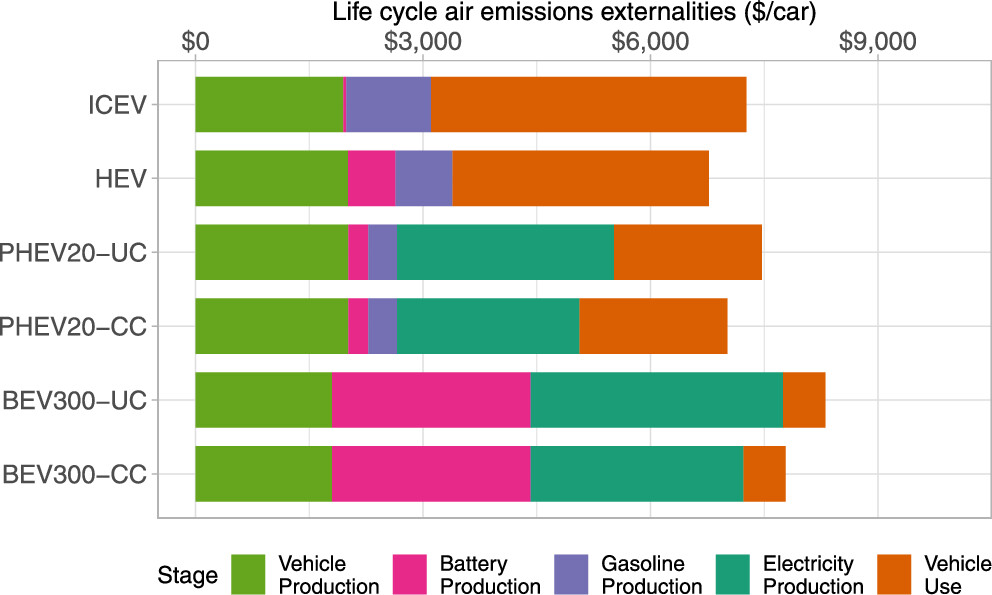
The paper actually refers to the grid on which I live, the PJM grid. On that grid, if one can understand the graphic and what the "green" stuff (electricity production) is - an unfortunate coincidence of color, since on my grid, PJM is decidedly not "green," a 12 month carbon intensity of 418 grams CO2/kWh, not as bad as China's but close - one can see that what makes an electric car in New Jersey dirtier than an internal combustion engine is the source of electricity, although embodied energy is also included.
Now, even if there are people - and this is surprising to me - who cannot differentiate between a device that is able to contain its byproducts on site, which what a nuclear plant does, and one that dumps its waste indiscriminately into the air, land and water, which is what a coal plant does - I can do so.
The carbon intensity of electricity in France is 31 grams CO2/kWh over a 12 month period which means that the electricity portion of the graphic above would be 31/418 = 0.07 as large, which means that an electric car in
France would be relatively cleaner than an internal combustion engine.
I'm certainly happy that I can tell the difference between a Rankine cycle nuclear plant and a Rankine cycle coal plant, even if the thermodynamic efficiency is equivalent. It has to do with the difference in the waste profile. A coal plant's waste kills people whenever it operates normally, since to operate, it cannot contain its waste on site. The used nuclear fuel in a nuclear plant, by contrast can be retained, and is retained on site, where it is subject to recovery of its valuable components in the case where scientific illiteracy about the subject is overcome.
Nuclear fuel has sustained high temperatures, much higher than the flame of coal combustion. This suggests that nuclear plants can be designed to utilize high temperature process intensification using heat networks. It does seem from my own BOE calculations as well as some I've encountered that in such a case, the thermodynamic efficiency of a nuclear plant can be doubled, much as the thermodynamic efficiency of combined cycle dangerous natural gas plants - dirty devices nonetheless - have more or less doubled in cases where they run continuously, which gas plants seldom do, but nuclear plants do all the time.
While antinukes prance around assuming in contempt of the laws of physics that electricity is "green" on coal based grids, hyping dangerous ideas about batteries and hydrogen charged or derived from fossil fuels, many modern nuclear engineers are designing a plethora of reactors designed to exploit nuclear heat to recover exergy and raise thermodynamic efficiency. It's hard to keep up with all these designs now.
When my son was entering his nuclear engineering program, I made sure to review with him the difference between heat engine cycles, in particular Brayton vs Rankine cycles. This is because he is a materials scientist as well as nuclear engineer. Brayton nuclear reactors have operated, but regrettably were not designed as combined cycle devices, Brayton and Rankine in sequence. This will change if the world comes to its senses and recognizes nuclear energy for what it is: The last best hope of the human race.
Thank you for your illuminating comment on thermodynamic efficiency, but I hope I've successfully demonstrated the difference between a coal plant and a nuclear plant if it seems mysterious.
By the way, there is one feature that both coal plants and nuclear plants share. Unlike the unsustainable solar and wind garbage people hype as the world burns, both coal plants and nuclear plants are reliable. Nuclear plants are superior to coal plants in this regard, beyond their obvious difference in environmental impact. As I noted the 30 most reliable power plants in the United States are all nuclear plants: Sorted by capacity utilization, a list of the largest power plants in the United States.
The thirty-first highest plant in the United States for capacity utilization is a coal plant is the Keystone coal plant in Pennsylvania, with a capacity utilization of 82.85%, with all the preceding nuclear plants having higher numbers. Only four of the 30 nuclear plants have capacity utilization below 90%. The best, Calvert Cliffs nuclear plant has a capacity utilization of 99.57%.
Since solar and wind plants are not reliable, they cannot, despite much delusional caterwauling to the contrary, replace coal. In fact, since a shut coal plant has to uselessly burn coal to bring up steam pressure before it can turn a turbine on, a coal plant is made worse if it is turned off for a while and restarted when the wind isn't blowing and the sun isn't shining.
Have a wonderful evening.
Edit history
Recommendations
0 members have recommended this reply (displayed in chronological order): = new reply since forum marked as read
Highlight:
NoneDon't highlight anything
5 newestHighlight 5 most recent replies
RecommendedHighlight replies with 5 or more recommendations
= new reply since forum marked as read
Highlight:
NoneDon't highlight anything
5 newestHighlight 5 most recent replies
RecommendedHighlight replies with 5 or more recommendations